Project Background
Designing a Japanese single-family home, known as ikkodate (一戸建て), presents a unique challenge: creating a complete family living space within a compact footprint. In Japan's urban areas, land is precious, and the typical family home must maximize every square meter while maintaining the warmth and functionality that defines Japanese residential architecture.
This project involved designing a 100sqm two-story home for a young family. The brief was clear: incorporate traditional Japanese elements while meeting modern lifestyle needs. Using SweetHome's AI tools, I was able to rapidly visualize floor plans and interior concepts, iterating quickly with the clients to achieve their dream home.
Design Philosophy: Japanese Efficiency Meets Modern Comfort
Japanese residential design has evolved over centuries to maximize limited space. My approach combined these time-tested principles with contemporary needs:
1. Multi-functional Spaces
In Japanese homes, rooms often serve multiple purposes. The traditional washitsu (Japanese-style room) can be a living room during the day and a bedroom at night. I designed the 6-tatami Japanese room to function as a guest room, meditation space, and children's play area depending on the family's needs.
2. Vertical Living
With only 50sqm per floor, vertical space becomes crucial. I incorporated built-in storage throughout, from the genkan shoe cabinet to under-stair storage and bedroom closets. The second-floor balcony serves double duty for laundry drying and as a small outdoor retreat.
3. Flow and Connection
Japanese homes emphasize smooth circulation between spaces. The open LDK (Living-Dining-Kitchen) concept creates a sense of spaciousness despite the compact footprint, while sliding doors allow flexible room configurations.
Space Planning: Two-Story Layout
The 100sqm is distributed evenly across two floors, each approximately 50sqm. Every space was carefully planned to maximize utility:
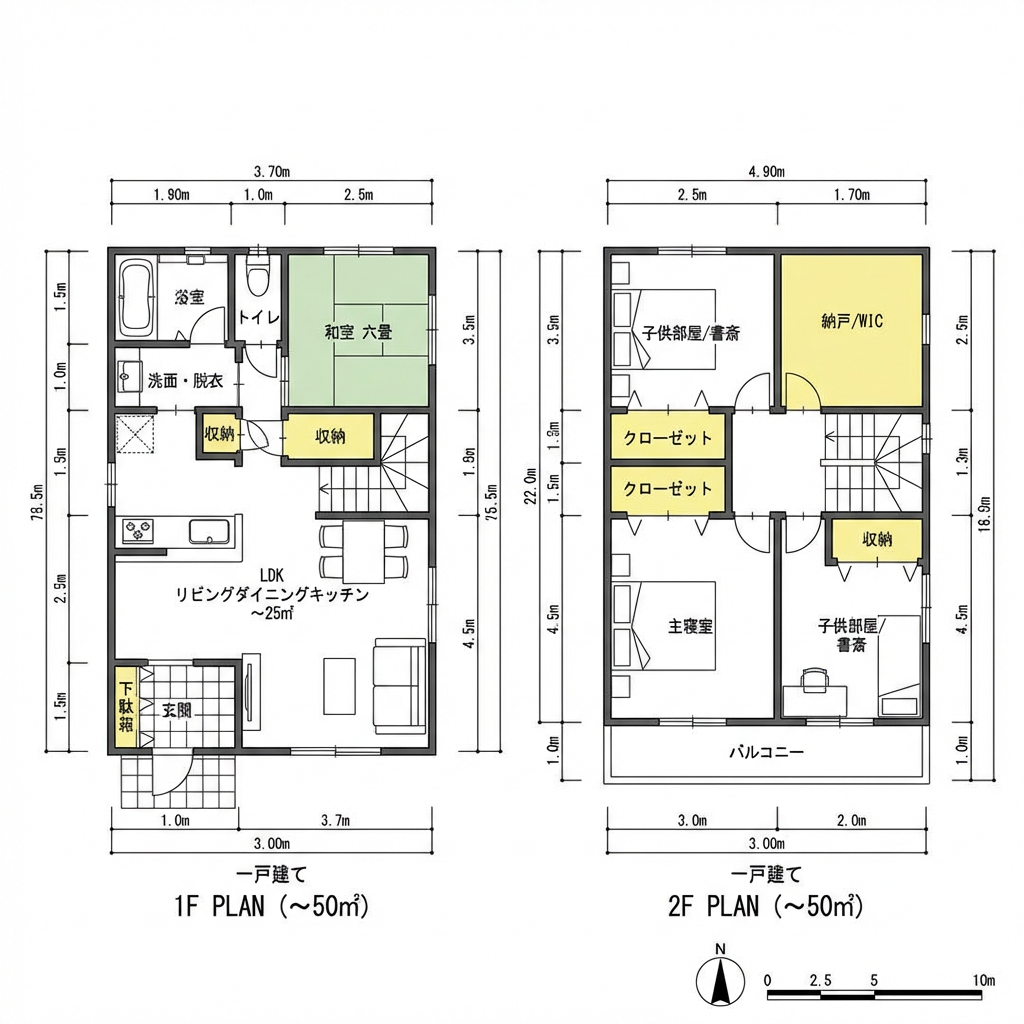
First Floor (1F): Public and Utility Spaces
- Genkan (Entrance): Traditional Japanese entryway with built-in shoe storage, maintaining the important indoor/outdoor boundary
- Open LDK (~25sqm): Combined living, dining, and kitchen area forming the heart of the home
- Washitsu (6-tatami): Traditional Japanese room with tatami flooring, serving multiple functions
- Bathroom Area: Separate toilet, bath, and laundry/utility space following Japanese bathroom conventions
Second Floor (2F): Private Spaces
- Master Bedroom: Parents' room with built-in closet and natural lighting
- Children's Room/Study: Flexible space that can grow with the children, with built-in storage
- Walk-in Closet/Storage: Essential storage space for seasonal items and family belongings
- Balcony: South-facing outdoor space for laundry drying and small garden
Design Decisions: Key Spaces
Genkan: The Threshold Between Worlds
The genkan is more than an entryway—it's a cultural boundary between the outside world and the sanctuary of home. I designed a compact but functional genkan with a step-up to the main floor, built-in shoe storage for the family's footwear, and a small bench for putting on shoes. The materials transition from tile at the entrance to warm wood flooring inside.
LDK: The Heart of Family Life
The open LDK concept is essential in compact Japanese homes. At approximately 25sqm, this space combines cooking, dining, and relaxation. I positioned the kitchen along one wall to maximize floor space, with a dining table that can extend for guests. The living area features low furniture to enhance the sense of space, with large windows bringing in natural light.
Washitsu: Preserving Tradition
The 6-tatami Japanese room was non-negotiable for the clients. This traditional space features authentic tatami flooring, a tokonoma (decorative alcove), and fusuma sliding doors. During the day, it serves as a quiet retreat or children's play area; at night, futons can be laid out for guests. The room connects to the LDK via sliding doors, allowing it to expand the living space when needed.
Bathroom: Japanese Bathing Culture
Japanese bathrooms follow a specific layout: separate toilet room, changing/laundry area, and the bathing room itself. The bathing room includes both a shower area for washing and a deep soaking tub (ofuro) for relaxation. This separation allows multiple family members to use different facilities simultaneously—essential for busy morning routines.
Bedrooms: Restful Retreats
The second-floor bedrooms prioritize rest and storage. The master bedroom features a built-in closet and south-facing windows for morning light. The children's room is designed to evolve—currently an open play and study space, it can be partitioned as children grow. Both rooms maintain the warm wood tones that flow throughout the house.
AI-Assisted Design Process
SweetHome's AI tools transformed how I approached this project, particularly in the floor plan visualization and space optimization phases.
Rapid Floor Plan Generation
Creating professional architectural floor plans traditionally requires CAD software and significant time. Using AI, I generated clean blueprint-style floor plans by describing the layout in detail. The prompt I used captured all essential elements:
"Architectural floor plan of a 100 square meter two-story Japanese house (一戸建て). Clean professional blueprint style with measurements in meters. First floor (1F, ~50sqm): Genkan entrance with shoe storage area, open LDK (Living-Dining-Kitchen) space approximately 25sqm, traditional Japanese room (和室) with tatami 6畳, bathroom with separate toilet, laundry/utility area. Second floor (2F, ~50sqm): Master bedroom with built-in closet, children's room/study with storage, walk-in closet or storage room, balcony for laundry. Show both floors side by side with room labels in Japanese."
Client Communication
The AI-generated floor plans allowed rapid iteration with clients. We could discuss room sizes, adjacencies, and flow without waiting for formal CAD drawings. This accelerated the design process significantly—what would normally take weeks of back-and-forth was accomplished in days.
Reflections
Designing a compact Japanese ikkodate reinforced a fundamental principle: constraints breed creativity. The 100sqm limitation forced every design decision to be intentional, resulting in a home where no space is wasted.
Japanese residential architecture offers timeless lessons in efficient living—multi-functional spaces, built-in storage, and the seamless flow between areas. These principles are increasingly relevant worldwide as urban density increases and sustainability becomes paramount.
AI tools like SweetHome don't replace the designer's understanding of culture and function—they amplify it. By accelerating visualization, they allow more time for the thoughtful decisions that make a house a home.
Design Your Dream Home
Whether you're planning a compact urban home or a spacious villa, SweetHome can help you visualize your vision.
Try AI Design Now